Capalbio Castle & City Walls
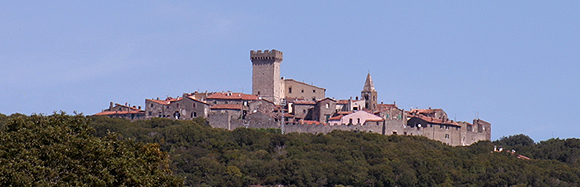 |
Capalbio is located in the southernmost part of the Province of Grosseto, just a few kilometres from Lazio, and can be easily reached by following the SS1 Aurelia to the exit “Capalbio”. It is the southernmost municipality in Tuscany.
Where
is Capalbio located?
» More Photos
 The Medieval
village of Capalbio is located on a hill
surrounded by lush Mediterranean vegetation on the furthest point of
the Tuscan Maremma, immersed in an important
natural environment. The territory was occupied by the Etruscans but
the first document citing
Capalbio is from 805, the official Leonino Carolingia bull with which
Charlemagne donated this land to the territory of the Abbey
of the Three Fountains in Rome.
The Medieval
village of Capalbio is located on a hill
surrounded by lush Mediterranean vegetation on the furthest point of
the Tuscan Maremma, immersed in an important
natural environment. The territory was occupied by the Etruscans but
the first document citing
Capalbio is from 805, the official Leonino Carolingia bull with which
Charlemagne donated this land to the territory of the Abbey
of the Three Fountains in Rome.
During the Middle Ages the zone went under the control of the Aldobrandeschi family and later under the control of the Orsini. In 1416 Capalbio went under the control of the Sienese enjoying a period of a renewed and florid commerce. In 1532 Charles V’s troops occupied the town and it was liberated thanks to the French troops. When it permanently fell under Siena, Florence took control of the area under the rule of Cosimo de’Medici starting a gradual decline of the town. In this period, Capalbio was practically the last stronghold facing the Spanish garrisons, therefore isolated, and malaria quickly took over the Maremma plains.
 Under
the Grand
Duchy of Tuscany of the Lorena, Capalbio
lost all of its administrative poker and was encompassed first by Manciano and
later by Orbetello. In the second half of the 1800’s, during
an intense period of banditry, Capalbio became a shelter
for outlaws and her in 1896, died the most famous
bandit of the time – Domenico
Tiburzi. Only in 1960 did Capalbio regain its administrative
autonomy.
Under
the Grand
Duchy of Tuscany of the Lorena, Capalbio
lost all of its administrative poker and was encompassed first by Manciano and
later by Orbetello. In the second half of the 1800’s, during
an intense period of banditry, Capalbio became a shelter
for outlaws and her in 1896, died the most famous
bandit of the time – Domenico
Tiburzi. Only in 1960 did Capalbio regain its administrative
autonomy.
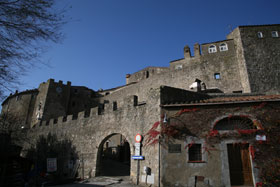
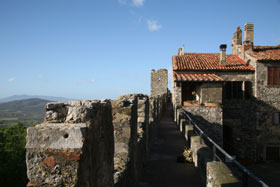
The historic center with its crenelated profile attracts attention from many kilometers away and is still surrounded by a double wall with walk walks on different levels which today may still be walked upon. The village is dominated by the massive Aldobrandesca Fortress at its highest point.
 The
first medieval enclosure, in local stone, was built
by the Aldobrandeschi between the 11th and 12th centuries for
defense and lookout purposes around the fortress, center
of the feudal powers of that period. During the 15th century,
the Republic
of Siena commissioned the modernization of the oldest
city walls. During
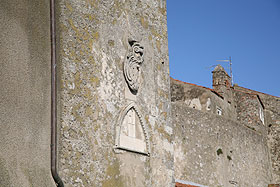
this intervention a second set of exterior walls and the Sienese
Gate were built where today a plaque from 1418 stands, reminding us of the
restructuring, and also a Medici coat of arms from 1601. Since then,
the walls have remained practically untouched up until today. Recent
work has brought back their ancient splendour. The walls are spaced around
a series of towers, almost all with a square base. The curtain walls
present traces of scarp bases on the external side and crowning
Guelf crenelations with some sections coinciding today with the external walls
of the buildings and for this reason we can see doors and windows opening
along the stone walls.
The
first medieval enclosure, in local stone, was built
by the Aldobrandeschi between the 11th and 12th centuries for
defense and lookout purposes around the fortress, center
of the feudal powers of that period. During the 15th century,
the Republic
of Siena commissioned the modernization of the oldest
city walls. During
this intervention a second set of exterior walls and the Sienese
Gate were built where today a plaque from 1418 stands, reminding us of the
restructuring, and also a Medici coat of arms from 1601. Since then,
the walls have remained practically untouched up until today. Recent
work has brought back their ancient splendour. The walls are spaced around
a series of towers, almost all with a square base. The curtain walls
present traces of scarp bases on the external side and crowning
Guelf crenelations with some sections coinciding today with the external walls
of the buildings and for this reason we can see doors and windows opening
along the stone walls.
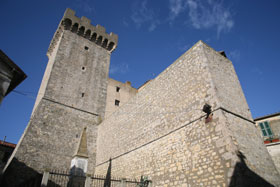 The Aldobrandesca
Fortress is situated at the highest
point of the village and is made up of a tower and an elegant
palace built between them. It was built in the low Middle Ages as part of the
land tenure of the Abbey of the Three Fountains in Rome. During the 13th
century it passed to the Aldobrandeschi family who enlarged it. After
a short residency of the Orsini family of Pitigliano and the conquest
by the Sienese at the beginning of the 15th century, the Fortress
of Capalbio became one of the southernmost strongholds of the Republic
of
Siena. The Sienese carried out restructuring work, giving the architectural
monument its actual aspect.
The Aldobrandesca
Fortress is situated at the highest
point of the village and is made up of a tower and an elegant
palace built between them. It was built in the low Middle Ages as part of the
land tenure of the Abbey of the Three Fountains in Rome. During the 13th
century it passed to the Aldobrandeschi family who enlarged it. After
a short residency of the Orsini family of Pitigliano and the conquest
by the Sienese at the beginning of the 15th century, the Fortress
of Capalbio became one of the southernmost strongholds of the Republic
of
Siena. The Sienese carried out restructuring work, giving the architectural
monument its actual aspect.
The tower is part of the original nucleus of the complex and presents quadrangular sections leaning on a cordoned scarp wall, the highest part crowned by crenelations built on shelves supported by blind arches. The elegant palace from the Renaissance, very close to the tower on the short wall is known as Palazzo Collacchioni.
| Back to Homepage |
| Castle Photos |
| Back to Castles Index |